

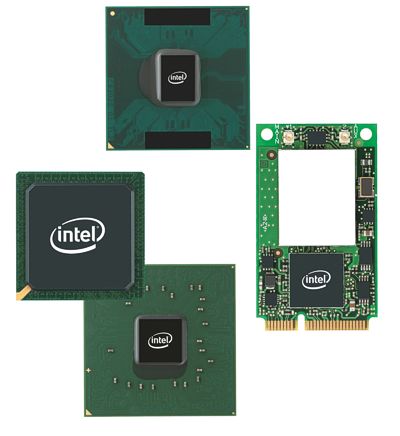
The fourth generation of Intel Centrino for mobile PCs in the form of Intel Centrino Duopresented these days used to be codenamed Napa. The key improvements which make the new version stand out from the previous platform codenamed Sonoma can be classified over the four vectors of progress:
- Performance increase – an increase up to 68% due to the use of new 2-core processors (results of the SPECint_rate_base2000 test)
- Elongation of the offline battery-powered operation – by up to 28% (according to MobileMark 2005 tests for the processor, chipset and wireless components
- Building systems in a finer and lighter form factor - reduction in the size of portable PCs by over 30% due to shrinking the physical dimensions of the platform components
- Expansion of wireless communication capabilities – support for the most recent security standards and wide selection of wireless connections
The name of the new platform - Intel Centrino Duo - quite vividly shows its key design feature: use of Intel Core Duo processors, first 2-core Intel chips for mobile PCs (formerly having the working name Yonah) created following the 65-nm process technology. Besides that, the full kit of Intel components to assemble a notebook computer that pretends to bear the Intel Centrino Duo logo, must contain the new-generation chipset Intel 945 Express and the wireless LAN adapter Intel PRO/Wireless 3945ABG with support for 802.11a/b/g protocols.
But the issue of marking to be used for Core Duo/Solo series processors with the cut-down L2 cache is still "in the air" (I am absolutely sure that chips similar to Celeron M will emerge within one or two quarters). Most likely, the respective logos will just be presented at the moment of their announcement.
Describing the overall specifications of notebooks based on Intel Centrino Duo for mobile PCs, Intel accentuates the improved 3D graphics, use of the HDTV, support for 7.1-channel Intel High Definition Audio with Dolby Digital. On the whole, notebooks demonstrate an increasing productivity due to a higher performance in the multitasking environment and improved facilities for shared work, as well as support for IP-telephony, IP-videoconferencing and prolonged time of offline battery operation.
The new platform also supports Intel Active Management Technology and Intel Virtualization Technology which improve the manageability and security of the PC, with the small dimensions of components making it possible to create notebooks of varied designs within a wide size range. It should be also mentioned that the operation life can be prolonged with the operating costs cut down with Intel Stable Image Program, There is also the possibility to prepare it for Windows Vista due to graphics optimized for the new Aero GUI.
0 comments:
Post a Comment